With the feast of Imbolc close at hand (Feb 1), I would like to introduce you to someone. This marks two years since epic stories began to arrive, stories begging for someone to tell them, mixing in myth and folklore with adventure and risk.
This week, I was attending a virtual writer’s circle event, with the prompt of character development using an object sacred/special to the character as a way to unpack something important to the reader–rather than simply just telling them so-and-so is such-and-such a kind of person. Use this object as a talisman to show us instead. We had 45 minutes.
45 uninterrupted minutes, what a luxury! My fingers flew on the keys, ready for the journey–a journey I would like to share with you, giving you a chance to meet some of the characters who have walked so closely with me these past to years, so far. May this short story/scene which emerged from the prompt (lightly edited for clarity) share something of them as well, inviting you into Finn’s world.
Beneath Finn’s shirt clinks three of his most precious possessions—silver amulets—the last gifts he has from his mother, who was burned as a witch.
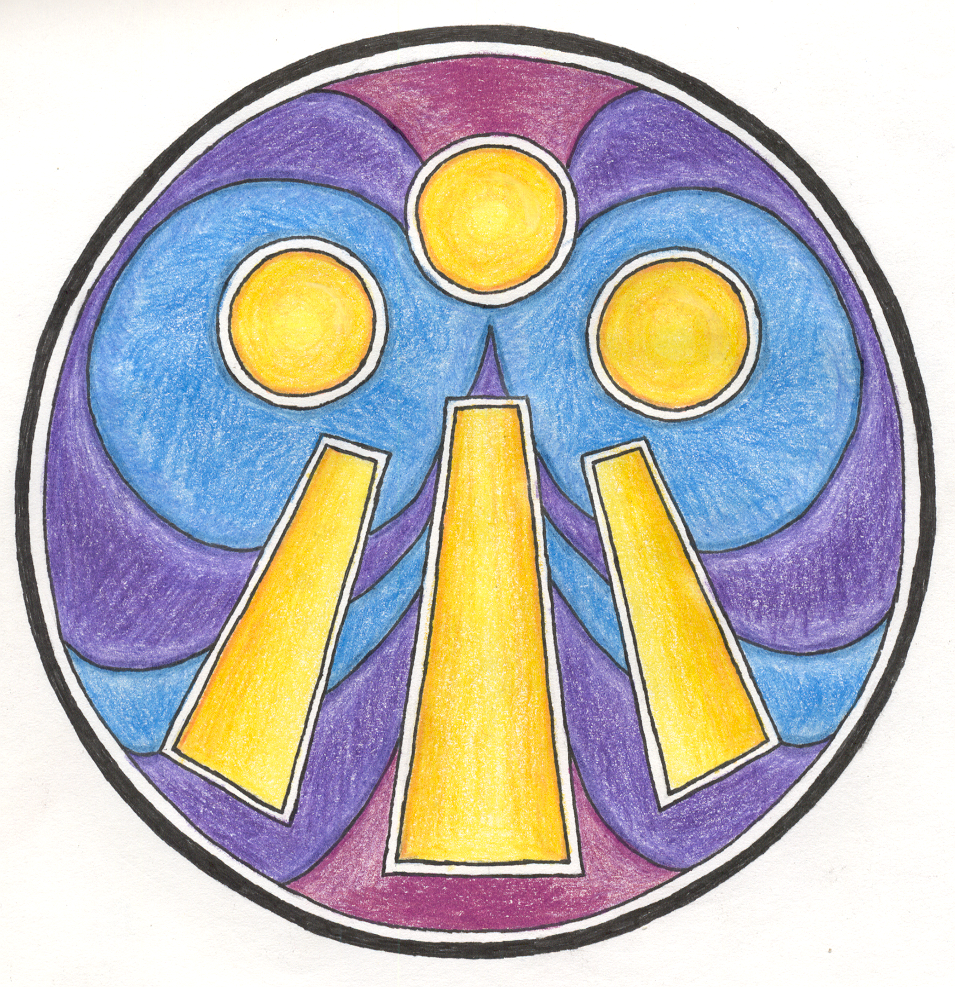
The first is the Celtic symbol of Awen, a circle with three drops of wisdom and three beams of inspiration—emblem of the bards. The second is the Tree of Life, with branches and roots intertwining, symbol of creation and connectedness shared by both the Celts and the Norse. And the third is Thor’s hammer, stout and axe-like, a symbol of protection, studded with curling knots. Each are threaded upon a silken string tied round his neck, kept shining by rubbing them between thumb and fingers whenever he is nervous or needs to think deeply.
Finn did not even know his mother had them, until Hlin gave them to him, when she brought terrified, nine-year-old Finn to Myrddin’s dugout home beneath the great, spreading oak tree, deep in the forest. It was her parting gift, before leaving him here, in the morning. The metal had lain cold against his skin, slipped beneath his pale, linen tunic.
If his mother had been wearing them, they would have shared her warmth. But there will be no more warmth from her, now that she is gone, snatched from their home by the angry priest with his cross held high, spurring on the shouting, vengeful villagers. But vengeful for what? His mother had been a healer, taking care of the women in their community. They had never harmed anyone. It was all very confusing.
Fortunately, life with aged Myrddin is less confusing, warm and simple, their earthen home with the roots of the oak tree like rafters a scholar’s womb, tucked with bookshelves and benches, odd bobbles and the old bard’s harp with the glinting, silver strings. Finn really hopes, someday, he might learn to play that harp, just like Myrddin.
His teacher has told him the story of where Awen comes from, how Ceridwen (the goddess of creativity) wanted to brew a magical potion for her ugly son, so he could be wise and revered as a councilor. Such a task would take a whole year, and the brew had to be kept ever-simmering over the fire—not too hot that it might scorch and not too cool that it no longer bubbled. But she would need to be out in forest and fields, collecting her ingredients.
So, the great goddess in her house on chicken legs (so it could walk about should she wish to be somewhere else) hired an old blind man to stoke the fire, and a young boy named Gwin Bach to stir the mixture for the year.
Sometimes, Finn envisions himself as little Gwin—especially when he is out in the forest with Myrddin, gathering herbs and mosses for tinctures and salves they make together, much like his mother had. There is something very much about home in the process, smelling the pungent, crushed leaves and how the fragrance clings under his fingernails afterwards, sometimes for days. There is much of Myrddin that feels of home, too, like a piece of his mother lingers in this man, though Finn knows not why.
Back to Gwin and Ceridwen. All had gone well enough, until the very last day of the preparation of this brew that would give her son great knowledge of all things. Little Gwin was standing on his stepstool, stirring and stirring. This became a harder and harder task, considering how full the cauldron grew, as each new herb and flower was added to the brew. The goddess was away, harvesting the last of her ingredients, when perhaps the old, blind man had added too much wood to the fire, for the brew sputtered and spurted, blipping and blopping. Suddenly, three drops of the boiling concoction flew out and landed on Gwin’s thumb! Ow! It burnt his thumb, and he instinctively stuck it in his mouth.
Suddenly, little Gwin knew all there was to know, and the thing he knew most of all was Ceridwen would be ragingly angry. Only one could gain knowledge from this brew—the first to taste it. She had warned him, on the day he had come to work in her service, her threats as fierce as an ice storm in January, and he had pledged and promised. Yet still, here he was, thumb in his mouth, and all he could think to do was run.
Finn knows about running. While not as angry, Myrddin has insisted, day after day, they must not speak to anyone they find in the forest. They must hide. They must remain a secret, sheltered like the amulets beneath Finn’s shirt. Once, the lad was foraging for chantarelle mushrooms, when he heard the hooves of horses. No! tucking his gathering basket between his teeth, he clambered up an ash tree as fast as a squirrel. Somehow, there were just enough branches in reach for him, until he was high in the canopy, curled up and shivering.
The hooves had clattered on, down the snaking, muddy trail through the woods. None of the riders in their liveried surcoats had glanced up to see him, and Finn had waited a long, long time, hardly daring to breathe, before climbing back down. Hiding is his life now—hiding from everyone else, in case they should be as angry as the men who killed his mother.
As Gwin ran, he could hear Ceridwen searching for him, screaming in rage. No! He turned into a fox, to run through the woods, and the goddess became a greyhound to chase after him. Then he turned into a salmon and slipped into a stream, and the goddess became an otter with sharp claws, paddling faster. Then Gwin turned into a sparrow to fly through the air, and the goddess became a falcon, swooping and diving to try to catch him.
In desperation, Gwin ran and ran, then saw a barn up ahead. Inside, peasants were threshing wheat. Clack, clack! Quickly, the boy ran into that barn and turned into a grain of wheat, hiding amidst the stubble of chaff on the floor. But Ceridwen became a big, black hen, strutted in, and ate him. And that was the end of that, or so she thought.
“Oh no, did Gwin die?” Young Finn rests by the hearth at his mentor’s feet, his arms round his own knees as he listens to the tale.
“No, my child, something else happened.” A twinkle lights Myrddin’s hazel eyes, his silvery beard like a frothy cascade over his flowing, woad-blue robes. “You’ll find in the old tales, when you eat something which is still alive, instead of death, there is rebirth.” Myrddin makes a rounded gesture over his abdomen. “From her choices, Ceridwen grew pregnant.”
“Oh!” Finn sits up at this, his dark eyes widening. “Was the baby Gwin?”
“Mmm-hmmm.” Myrddin chuckles, his soft smile knowing. “In a new form. But let me continue.”
Nine months after the shapeshifting chase, Ceridwen gave birth to a baby boy. She knew who this was—no doubt about that—and she was still angry for all her work having been wasted. But she had not the heart to kill her own child, so instead she tied him up in a leather sack and threw him out to sea, for the fates to do what they will.
In a village, not far off, lived a luckless man named Elffin. He had tried his hand at everything! But alas, all was a failure. His crops withered and died, he broke every tool he borrowed, livestock ran away from him, and he seemed clumsy at everything. But he kept trying! This day, he begged and begged and begged his uncle for a chance to borrow a boat and go fishing. His uncle was none too pleased to lend him one, but at last Elffin pushed out to sea.
He cast his nets to the right, but caught nothing, then cast them to the left, and still nothing. Then with one last heave, the nets pulled in heavy, and Elffin leaned over the rim of the coracle, eager to see his catch. But it wasn’t fish. It wasn’t eels. No, it was some leather bag, tied up with a string. Sunken treasure? Discarded wares? He pulled the parcel into his boat, untied the sack, and gasped to see this was a baby, with shining golden hair. And the remarkable child looked up at him and began to speak in words of elegant poetry.
So Elffin took him home and raised the boy as his own. He named him Taliesin, which means “shining brow,” and that child would grow to be the greatest bard in all Old Wales.
“We still recite some of his poems today.” Myrddin sits back in his rustic chair, nodding in satisfaction. “And so, Awen bears those three drops of brew that landed on the boy’s thumb, shining down beams of divine inspiration, which guide the bardic path, even to this day. These are truth, nature, and knowledge, and we must honor them always.”
“Woah!” Finn grins with delight at the tale, tucking his straight, brown locks behind his ears. “Imagine turning into all those animals! Can you do that, great teacher?”
“Heh, no. This was all some time ago, and I’ve not had a taste of Ceridwen’s brew. But you never know, right? Sometimes life surprises us.” The old man grins in his fond way. “Now, where were we with your studies in Latin?”

I love hearing from friends! Have a question, idea, or request? Please use this form to send your message, and the internet Raven will wing it my way !