“I want to tell you something.”
I looked up from my stand at the small-town farmer’s market, surprised to see an earnest but nervous expression on the face of a mature, indigenous man. While I recognized him, I’m afraid I cannot remember his name.
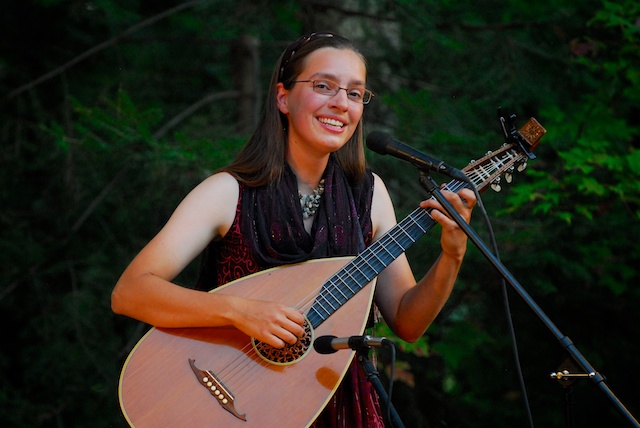
“Your album, that last track.” He points at the lute-bodied guitar I had been strumming while singing ballads to pass the slow part of the day. The other vendors have come to enjoy serenade sessions as well, and sometimes other locals would join in and we’d jam together.
“Yes? From my first album?”
“Yeah. Scarborough Faire. Sometimes…late at night…” He winces as if reliving something worrisome. “Well, sometimes I have to go to parts of the reservation I don’t want to at that hour, to repair things. So, I play your song, over and over, in the car. And then I’m alright. I just wanted you to know.”
I blinked, shocked and touched at this story he wanted so openly to share with me. “Thank you. I’m grateful it helps your soul.”
Is that not the work of the artist in this life? To touch others so deeply like this?
Many who grew up through the Folk Revival era associate Scarborough Faire with its stock verses and impossible tasks with musicians Simon and Garfunkel. But theirs was a reworking of a song much, much older. Following the roots of folk traditions usually ends in undocumented obscurity, but we do have the lyrics in a journal entry from 1603, at which time it was noted as being overheard, not composed by the pen who captured it onto page.
And as with many folk traditions, different variants sprung up from other overhearings, including riffs on the refrain:
Parsley, sage, rosemary, and thyme.
Every rose grows merry in time.
Every rose grows bonnie with time.
Some treat it as a chason, where one lover offers impossible tasks to the other, then the second offers equally impossible (but different) tasks in return. Take these examples.
Tell her to make me a Cambric shirt,
Without one stitch of needlework.
Tell her to wash it in yonder well,
Where nary a drop of water e’er fell.
Tell her to dry it on yonder thorn,
That never bore blossom since Adam was born.
Which is met by:
If he presses these questions three,
Then I shall have as many for he.
Tell him to find me an acre of land,
Between the saltwater and the sea strand.
Tell him to plow it up with a lamb’s horn,
Then sow it all over with one peppercorn.
Tell him to reap it with a sickle of leather,
And bind it up with a peacock’s feather.
When he has done and finished his work,
Then tell him to come and he’ll have his shirt!
Francis James Child, a Boston academic took an interest in collecting variants of ballads, and later Bronson worked to collect a diversity of melodies to match them, which were compiled into four huge tomes. I would pour over these in the forgotten corners of university libraries, fascinated by there being not just ONE version of this love song.
And if there are so many alternatives, why settle for what everyone recognizes?
That’s when it clicked. I could also be a node on the folk tradition and make my own variant, piecing together parts that was neither a chanson (poetic love duel) or a hopeless list of tasks that could never be—for lambs have no horns, leather sickles cannot cut, Cambric cannot be turned into a shirt without stitching, and a dry well offers no water for washing.
Then I found it, on one dusty page in Bronson’s collection—a verse I had never seen before, right at the end of the song.
If she tells me she can’t, I’ll reply,
Parsley, sage, rosemary, and thyme;
Then tell me that at least you will try,
Then you will be a true love of mine.
And I knew that was it. For we are never perfect in love, but this idea of being willing to try even the impossible for the sake of love stuck with me, and that’s the version I chose to perform and record.
“I play it over and over. And then I know it will be alright.”
Why?
Hope. Hope even against the seemingly impossible.
With love, we pick ourselves up, take a deep breath, and try.
And that is the power of narrative that does not settle for what has been always repeated. It’s looking for the deeper piece that resonates, something both timeless and new—renewed.
Are you going to Scarborough Faire?
Parsley, sage, rosemary, and thyme;
Remember me to one who lives there,
For she once was a true love of mine.
As featured in Legends of the Troubadours. Find Laura’s albums at
https://northstarhomestead.com/product-category/gifts/music/

I love hearing from friends! Have a question, idea, or request? Please use this form to send your message, and the internet Raven will wing it my way !
One Response
Well said!!!!