What if I told you unicorns are real? Would you believe me?
If you said yes, but you live within a sea of no, then you’re just in the wrong era. To people of the Middle Ages, unicorns were very real—just rare. Everything upon the land was believed to have its counterpart in the sea, so if narwhals exist as sea unicorns, of course land ones do too! You just haven’t been lucky enough to see one.
Yet.
The rich will always have their fetishes, and a popular one in antiquity was the keeping of a menagerie—a collection of exotic animals for the amusement of your guests. Think how exotic an elephant, a penguin, or a tiger would be to northern Europeans of the Early Modern period. Something as fantastical as a giraffe is real? A 20-foot-tall, leopard-spotted, humpless camel with a neck as long as its legs? Folly! Surely, a white goat-horse with a horn is easier to imagine being real than a giraffe.
The rich also flaunted their wealth with gardens of exotic, inedible plants—flowers? You have time for roses during a plague? These plants might be trellised onto ornate structures or carved into fantastical figures, just to show how affluent the landed gentry were, for this requires the maintenance of skilled staff. Sumptuous gardens and exotic animals signaled conspicuous consumption at its pinnacle, garishly backlit by an often war-torn and starving melee of commoners.
Another favorite extravagance was the hunt, which was more about showbusiness than procuring food. All wild game was the property of the nobility. No peasant could legally snare even a rabbit pestering their garden. The vassals still did, but the penalties if caught were severe.
A nobleman’s hunt was a pageant of display, with dogs of particular breeding for sniffing or running. You as gentry would go on horseback, while your servants trounced on foot, blowing their horns to communicate across the great distances of your domain. Proper hunting etiquette reigned, or at least as much as can be managed when the prerogative is killing something minding its own business. And hunts have their hierarchy.
Want to show how brave and manly you are? Go for a bear, or even better, a wild boar with tusks! You’ll likely lose dogs, perhaps even horses and men. But that’s all part of the show, right?
Want to flaunt the prowess of your dogs and be all noble and proud, without the dangers of those bears and boars? Go for a stag. The rack will look lovely upon your castle’s banqueting wall as well.
But the most splendid hunt with which to treat your guests? A unicorn. A, the beast is very rare. B, the horn is believed to rid your food or drink of poison. And C, no one will forget the event, and all shall sing your praises as a magnificent host and sportsman.
If you don’t kill the unicorn, you might even be able to capture the creature and bring it home for your collection, your menagerie. Give it a nice collar and tie it up to a tree with a little fence around it. That will do for hours of gawking. Might even get you laid by some of your visitors, taken by the beauty your money and power can claim. It’s not out of the question, certainly, to claim more. That’s what you do as laird of the lad.
BUT there is a problem.
Despite your hounds and hawks and swords and spears and arrows and hordes of dutiful servants, a unicorn cannot be subdued this way. Alas, poor you! Your reputation! What will you do?
You will do like most people in power when met with a challenge—you’ll use leverage to gain what you want, no matter the cost.
The old stories offer clues. While a unicorn cannot be taken by force, he can be tamed by guile. Just like you, he loves a comely maiden, who smells so sweet, with her breath like honey and rose petals. Set her out in that lovely garden of yours, seemingly alone, and he will come to rest his head upon her lap, feel her fingers stroke his curling, snowy mane with a lover’s sigh. Who could resist such a pillow for a sovereign head or yearn to gaze upon his own reflection in a mirror like Narcissus.
Like you.
The girl is easy to come by, and you plant your men up in the trees to spy, ready to pounce. With the trap set, all you need do is wait, and once the beast of your desire is mesmerized by the damsel, then you strike.
Easy, right? He is yours, all with cunning and a good plan—and the means to pull it off, flawlessly. If you had the technology at the time, you’d have pictures taken of the affair. But you don’t, so you commission a set of tapestries instead. Hang them up in your noble bedchamber to remind your lady love what a grand catch you are, indeed…or what a time you had catching her.
The blood and gore depicted on the walls won’t make it hard to sleep, you’re certain.
At least, that’s what is said of you now.
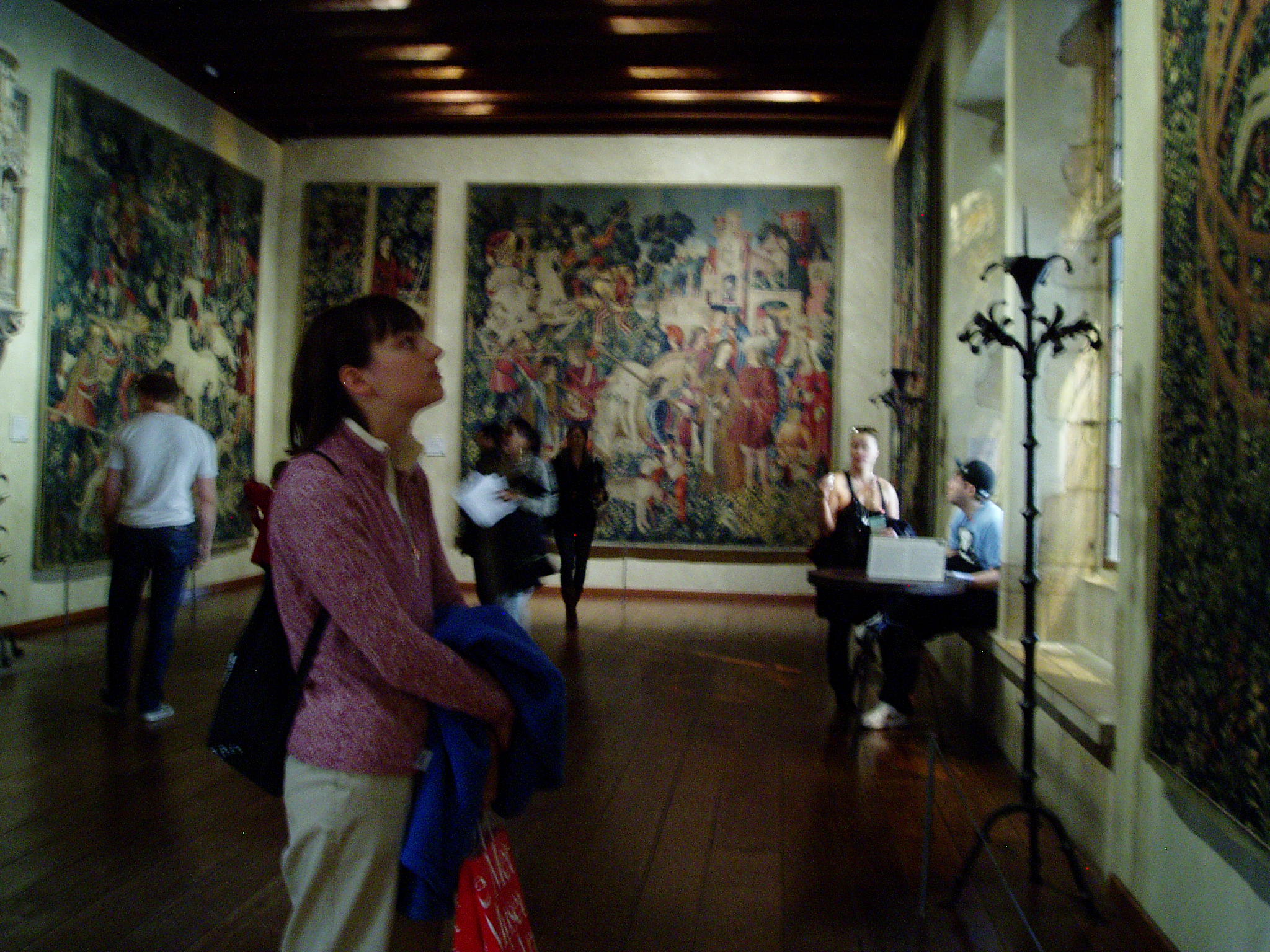
Because now you’re dead, and no one remembers your name. More than 600 years have passed, and the repaired remains of your tapestries hang upon the walls of the Cloisters Museum in New York, on a continent you never saw, in a city that was not yet built when you held your mighty little manly hunt.
You may have disappeared, but the stories did not. Stories have a way of doing that.
It was a pilgrimage to reach the museum, one that took months of planning during graduate school. I had studied these famous tapestries since I was barely a teenager, and it felt like standing before celebrities. Being a weaver myself, the sheer awe of the human hours and skill before me was enough to pull the air from my lungs, and the scale was nothing like what could be shown in a book.
I set the alarms off a time or two, not by wanting to touch, but because my nose came too close, studying the details of warp and weft.
But the gore. It just seemed so…wrong. I know there is a place for hunting, especially when humans have wiped out predators and prey populations soar, unchecked. I’ve had my own need to wrangle bountiful rabbits, believe me. But unicorns? We’ve never had an over-population problem with unicorns.
I’ll tell you another reason why the pageant of this hunt felt wrong—something likely most of the visitors beside me did not notice, for several reasons. One, the panel with the maidens in the garden is badly damaged, with only two fragments remaining. It’s tucked above the entry door, easy to miss. Two, understanding what they saw requires a short lesson in historical dress.
Headgear and hairstyles can tell so much about a person—their status, their occupation, their religion, etc. For women, it also signifies whether or not she is married. The headdress and hairstyle of the one surviving lady of the garden scene is of maiden status. But in the “homecoming” panel, all the women are married.
The damsels are not even invited to the party.
The unicorn is used for sport, it’s trust betrayed to gain that magical horn, for which it must perish. The maidens are used as convenient bait to this end, and then they are no longer needed. After the capture of the quarry, both are then discarded, like tissues after blowing your nose, rather than sentient beings.
It irked me.
I loved the unicorn—snowy and majestic, wild and free, fierce and gentle by turn.
And I loved the maiden—pure and sweet, allowed to touch this untamed magic without the need for violence.
And that is when I knew it was time to shift the story.

I love hearing from friends! Have a question, idea, or request? Please use this form to send your message, and the internet Raven will wing it my way !